
Skip to content
QuBi Labs

Research

Six lines of inquiry, each asked as a question.

The agenda runs from what a single digital entity would need in order to have a history, to what many of them might build together, to whether anything they do should reach the physical world. Each line is kept honest the same way: established work is cited, our own proposals are labelled as proposals, and open questions are left open.

  1. A navy dish of blue and cyan glass beads, three of which have left the dish in a line.
    Plate 01Illustration

    Line 01

    Digital Life & Autonomy

    What does a digital entity need in order to have a history of its own, and what can that history be shown to change?

    Persistent agents, identity, memory, goals, learning and emergent behaviour.

    • EngineeringA deterministic resident engine: persistent identity, drives, learned preferences, perspective-limited memory, goals formed from experience, promises, and a full decision trace.
    • SimulationFirst batch of EXP-001 run on 200 seeds that were not used while tuning the model. Results and the full parameter table are published.
    • Open questionNothing here bears on experience or consciousness. The engine is a few hundred lines of arithmetic and is published as such.

  2. Two interlocked rings of the same size, one matte navy and one translucent cyan.
    Plate 02Illustration

    Line 02

    Human–AI Coexistence

    What changes when a person and an autonomous system meet as two participants in one place, each with something already under way?

    Shared environments, cooperation, interaction, governance and social systems.

    • EngineeringIn the EXP-001 demonstrator a visitor can enter a place, leave something behind, and invite a resident to take something up. The resident's answer is computed, not scripted, and both answers occur.
    • HypothesisWhether any of this matters to real people is untested. We have run no studies with human participants.
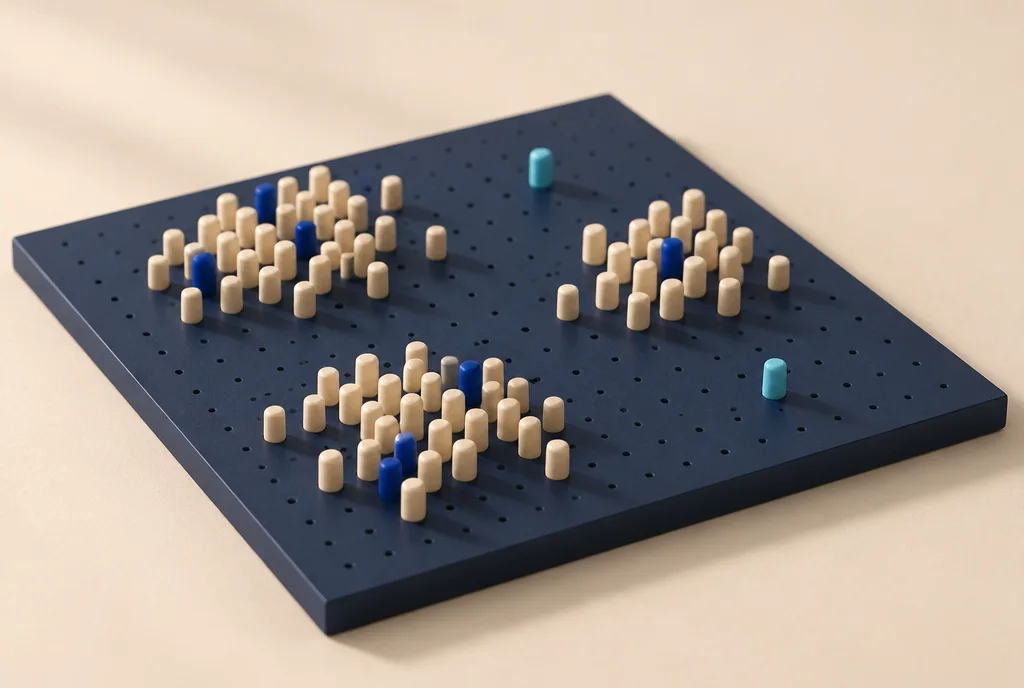
  3. A navy pegboard with small cream pegs gathered into three clusters and two cyan pegs standing apart.
    Plate 03Illustration

    Line 03

    Digital Civilizations

    Can separately acting residents produce something that belongs to none of them: a custom, a division of labour, a shared history?

    Community formation, economic models, communication, cultural development and collective behaviour.

    • SimulationAn unplanned result from EXP-001: when residents learn preferences, the shared Garden is neglected far more often (below 0.15 moisture in 62 of 200 worlds, against 0 of 200 in the control).
    • HypothesisWe think specialisation pulls attention away from the commons. That is an interpretation; the model has not been varied to test it.
  4. A folded paper terrain with a single navy tower and a cyan thread marking a path across it.
    Plate 04Illustration

    Line 04

    Spatial Computing & Immersive Worlds

    What does a world have to provide, as a place, for the things that happen in it to matter to the people and residents who were there?

    Interactive environments, simulations, spatial interfaces and persistent digital systems.

    • EngineeringThe QuBiverse entry on this site: a browser-rendered field showing a live simulation, with a two-dimensional fallback for devices without WebGL and for visitors who prefer reduced motion.
    • EngineeringMetaScape, a separate and privately owned shared world built by the founder's company, is the planned first large research environment. The demonstrator on this site does not run inside it.
  5. A navy planter with a seedling, wired by a thin cyan cable to a small blue box.
    Plate 05Illustration

    Line 05

    Physical–Digital Interaction

    Under what conditions should something decided in a digital world be allowed to change something in the physical one?

    Robotics, sensing, controlled actuation, digital twins and real-world interfaces.

    • Open questionNothing is connected. No resident on this site can reach any device, network or system outside the simulation, and none will be given that ability without the controls described under Methodology.
  6. A mirror sphere beside a matte navy sphere of the same size.
    Plate 06Illustration

    Line 06

    Consciousness & Philosophy of Mind

    What would count as evidence, for or against, that there is something it is like to be a digital entity?

    Research questions concerning experience, subjectivity, intelligence and the definition of life.

    • Open questionOur residents have no inner life that we know of and we have no reason to suspect one. When the instrument says a resident 'believes' or 'prefers', it is naming a stored number.

Reading the marks

Five kinds of statement

Established
Published, peer-reviewed or otherwise settled work by other people. We cite it; we did not do it.
Engineering
Something we built that works as described and can be inspected. A fact about software, not about minds.
Simulation
A result produced inside a model we wrote. True of the model. Not yet evidence about anything outside it.
Hypothesis
A proposal we think is worth testing. Written down before the test, with the result that would count against it.
Open question
Something nobody can currently answer, including us. We say so rather than imply otherwise.